![[Translate to English:] Les missions de Planète Sauvage](/fileadmin/_processed_/a/3/csm_Tigre-de-malaisie_f41cdb5b5f.png)
[Translate to English:] Les missions de Planète Sauvage
[Translate to English:] Les missions de Planète Sauvage
Planète Sauvage's Missions
As a zoological park, Planète Sauvage's mission rests on 4 core principles that guide the work of every team at the park:
- Animal welfare
- Conservation
- Education
- Scientific research
Through these missions, and backed by its expertise, Planète Sauvage is a genuine ambassador for wildlife protection. By visiting us, you too become an actor in safeguarding biodiversity!
0
animals
0
species
0 HA
over
Toutes les questions que vous vous posez et les idées reçues sur notre rôle en tant que parc animalier
Toutes les questions que vous vous posez et les idées reçues sur notre rôle en tant que parc animalier
All the animals you can observe at Planète Sauvage are entrusted to the care of our specialists, who meet each individual's needs on a daily basis. Their dedicated work provides every resident with a positive, comfortable life experience.
5 core animal welfare commitments
Animal welfare is a serious subject grounded in solid scientific knowledge, organizing the work of animal care teams around 5 main pillars:
- Guaranteeing access to fresh water and food in quantities and variety suited to a healthy diet
- Enabling the expression of natural behaviors in suitable environments (exploring, socializing, breeding, etc.)
- Providing an environment experienced as comfortable by each species (warmth, shelter, shade, access to water points, etc.)
- Protecting against sources of stress or fear within the natural haven of Planète Sauvage's 100 hectares of plains and forests
- Guaranteeing access to the best care, thanks to the expertise of a specialized veterinary team using modern technology
5 commitments
Dedicated teams
4 Vétérinaires
![[Translate to English:] Les missions du parc](/fileadmin/user_upload/planete_sauvage/communique_presse/phototeque/Loup_arctique.png)
0
Programmes de conservation
0
espèces menacées
0 naissances en 2024
Plus de
Planète Sauvage is a place for protecting biodiversity, home in particular to animal species that are endangered or extinct in the wild. The care given to the animals, as well as breeding, actively contributes to protecting them from extinction.
Species conservation is built around 2 fundamental areas:
- In situ conservation: within the natural habitat
- Ex situ conservation: outside the natural habitat
In situ conservation
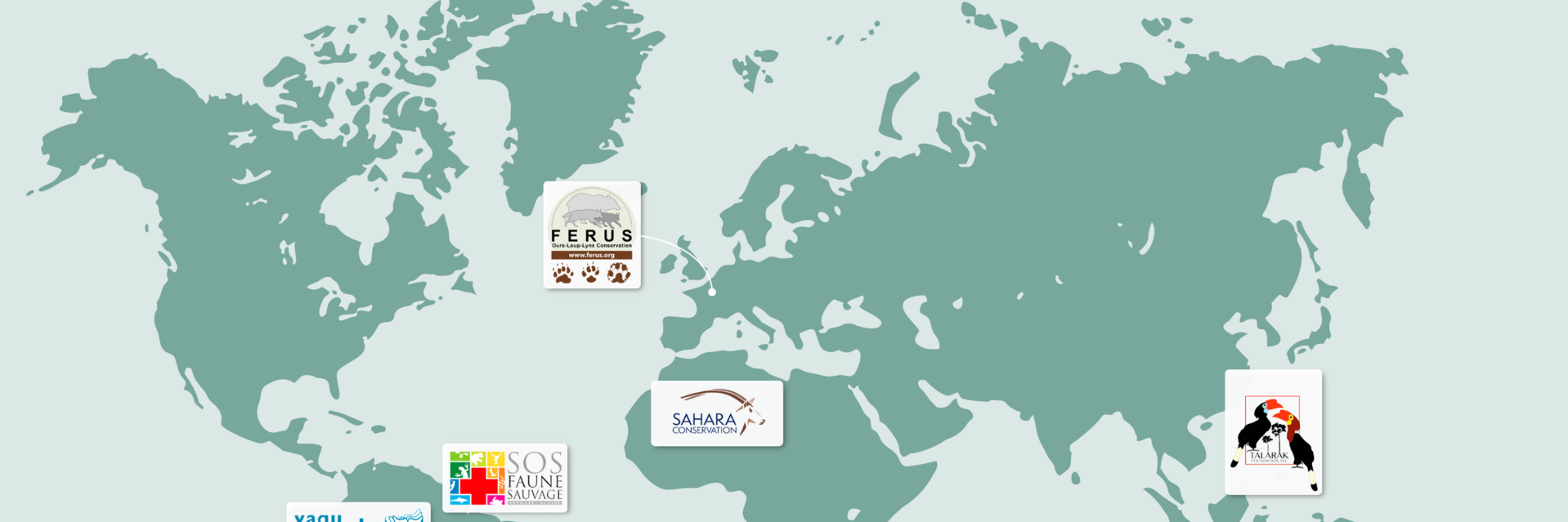
In situ conservation aims to preserve and maintain endangered species within their natural habitat. The Planète Sauvage Nature association gets involved and supports local associations working in the field to protect wildlife around the world.
Our actions respond to various needs, whether urgent or longer-term — for example:
- In 2020, faced with the terrible fires in Australia and the Pantanal (South America), Planète Sauvage Nature released emergency funds and set up online fundraisers to help local associations rescue animals in serious danger.
Supported Projects
Ex situ conservation
Ex situ conservation
Ex situ conservation represents methods of conserving wild species outside their natural habitat — one of the essential missions of zoological parks. To help safeguard wildlife, the European Association of Zoos and Aquariums (EAZA) has set up animal exchange programs between parks to regulate and optimize breeding. These exchanges involve no financial consideration: wild animals are neither bought nor sold by parks, in order to help combat animal trafficking.
There are two types of exchange programs coordinated at the European level, in which Planète Sauvage participates:
- EEP programs (European Endangered species Programme): the most comprehensive management program for individuals of a species, each coordinated by a European coordinator recognized for their expertise on that species.
- ESB programs (European StudBook): a management program that maintains a precise register of individuals of a species across zoological parks. These species are less threatened than those classified under EEP, but are at risk of becoming so.
The goal of these programs is to preserve 90% of genetic diversity over a 100-year period, in order to maintain individuals' ability to readapt to the wild, enabling reintroduction or population reinforcement where appropriate.
Raising visitors' awareness of the threats facing wildlife, and turning each of us into an actor for protecting our planet and its living heritage, are core missions of zoological parks.
At Planète Sauvage, we take this mission to heart — we even have a dedicated team!
Better knowing and understanding animals, and the dangers threatening them, helps everyone become more aware of the need to protect them. The tools and experiences we develop at the park aim to showcase the beauty and richness of biodiversity, as well as everyday actions that help protect it.
0
guided experiences
0
dedicated team
Educational tools
Educational experiences open to everyone
- The dolphin presentation: a fun, educational presentation that delivers a strong message in a concrete, illustrated way.
- The visitor guide: handed out to every visitor, it presents the various coordinated breeding programs of zoological parks as well as each species featured on the Safari Track.
- Information panels: throughout the walking visit, panels present the different species, their geographic distribution, and the threats they face in the wild.
- Actions led by Planète Sauvage Nature: for example, we set up an information stand about the Pantanal fires and the urgent threats to local wildlife (2020).
To go further
Planète Sauvage offers various experiences guided by animal keepers, to dive deeper into the animal world and the work of zoological parks:
- The 4x4 Raid
- Meeting the Dolphins
- VIP Safari
- Keeper for a Day
- Junior Keeper
- Holiday camp – Apprentice Keeper
- Bivouac in Mongolia and Bivouac in Tanzania
- Workshops for children's groups
Understanding animals to better protect them
CREAS (the Center for Research and Studies on Wild Animals) is the body responsible for coordinating Planète Sauvage's scientific activity.
The opportunity to study animals, made possible by zoos, is recognized as one of the essential tools in the fight against biodiversity loss.
Since 2008, Planète Sauvage's teams have collaborated with numerous scientific institutions. These collaborations have led to significant advances, such as a better understanding of animals' perceptual world, objective assessment of animal welfare, and their social lives and communication systems.
After more than thirty publications and numerous international collaborations, Planète Sauvage strengthens its scientific commitment to animal welfare every year.
We are facing the sixth-largest mass extinction of species, and initiatives to protect wildlife are multiplying everywhere. To be effective, these biodiversity protection programs, carried out jointly in zoological parks and in the field, must be based on detailed, solid knowledge.
Planète Sauvage offers scientists from around the world privileged access and observation conditions for more than 120 species of wild animals. Geneticists, veterinarians, ethologists, ecologists, and specialists in nutrition, reproduction, and animal welfare all find answers to their questions here.
Strong scientific partnerships
Planète Sauvage's scientific department maintains close ties with renowned scientific organizations, hosting researchers and their students on-site.
Our scientific department also regularly hires future PhD scientists, who spend three-year periods conducting research within Planète Sauvage's scientific department in order to complete their doctoral thesis.
In return, our research benefits from strong expertise and quality technological support.
0
theses
0
publications
0
ongoing study

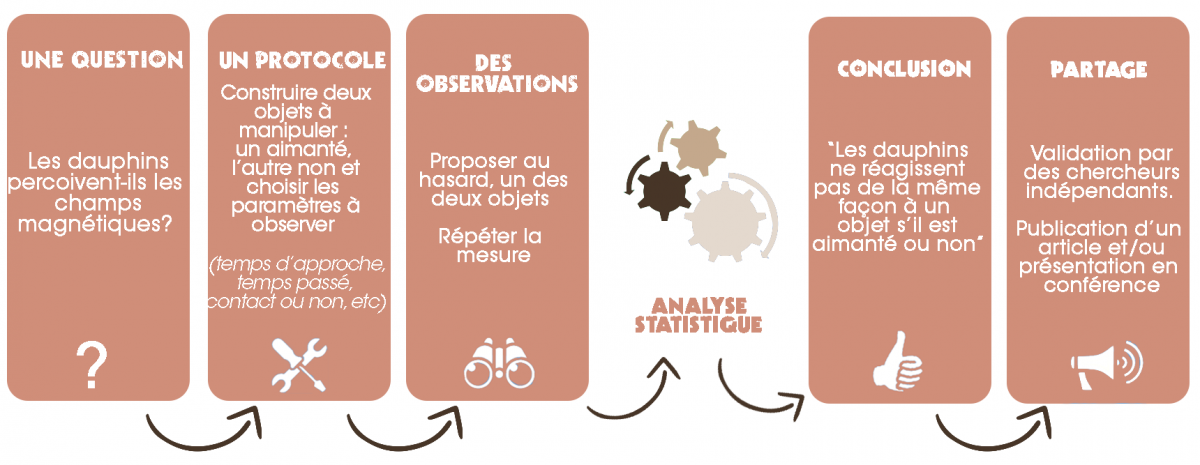
La démarche scientifique : comment ça marche ?
What's the purpose of this research?
What's the purpose of this research?
A classic distinction is made between fundamental research (expanding our knowledge) and applied research (developing tools).
An example of fundamental research, made at CREAS
D. Kremers' thesis (2013): Diving deeper into the dolphin's Umwelt: Acoustic, gustatory, olfactory and magnetic perception. Rennes 1.
From 2010 to 2013, Planète Sauvage sought to answer several questions about dolphins' abilities to perceive their environment: How is their vision organized? Can they react to smells and tastes? Do they have access to other senses?
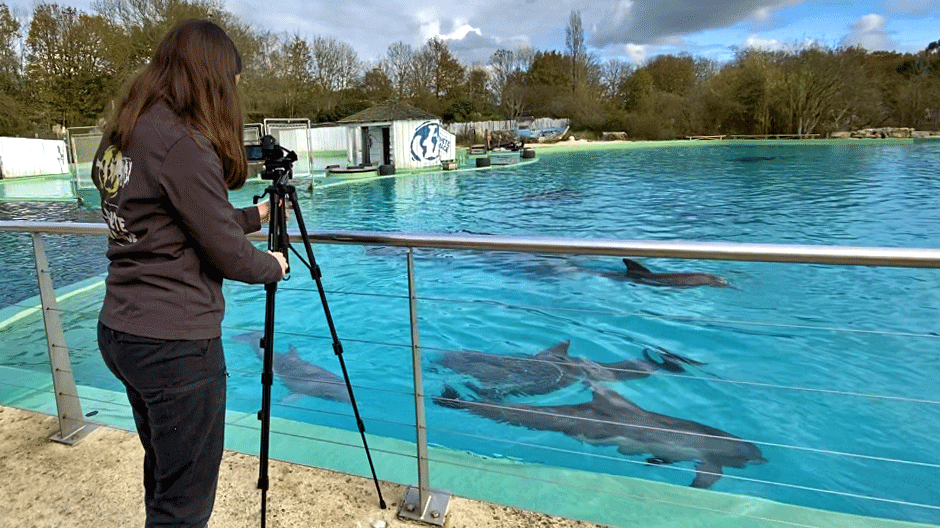
To answer these questions, a set of playful experiments was designed to encourage spontaneous engagement from the animals. These experiments were entrusted to a biology PhD student specially recruited for the purpose. She presented and defended her work before a thesis committee, then published the results in international scientific journals.
Thanks to these rigorous observations, it was shown that dolphins — contrary to what was previously believed — are able to use their sense of smell and distinguish complex tastes. Surprisingly, they are also able to perceive magnetic fields!
All these groundbreaking findings are fueling new research, helping people on the ground better understand dolphins' interactions with their environment and improve measures to protect them.
An example of applied research, made at CREAS
Today, 4 of the 5 rhinoceros species are vulnerable or critically endangered. These animals, victims of poaching, reproduce slowly, and every birth — in a zoo or in the wild — is one more step toward their survival.
In 2019, a team from the University of Hanover came to study, in partnership with Planète Sauvage's scientific team, male and female behavior during the mating period. We were able to identify subtle changes in vocalizations and postures at the moment when the female is most receptive.
Jenikejew, J., Wauters, J., Dehnhard, M., & Scheumann, M. (2021). Linking socio-sexual and vocal behaviour with faecal progesterone and oestrogen metabolite levels in Southern white rhinoceros females. Conservation Physiology, 9(1): coab098.
These indicators help zoos better organize introductions between animals, and help reserves and national parks determine periods requiring extra vigilance, to provide the calmest conditions and give these animals the best chance of reproducing.
NE RIEN MANQUER DE L'ACTUALITE DU PARC
Inscrivez-vous à la newsletter et suivez l'actualité du parc et des animaux!


